FROM THE XORTH TEAM

What's New

Regulatory changes that affect Indian sites, practical notes on EHS measurement, and what we are learning building computer vision for real camera estates.
Frequently Asked Questions

How Xorth connects, what it detects, and where your video is processed.
General
How does Xorth work with our existing cameras?
Expand answer
Xorth connects to your existing IP CCTV over RTSP through your NVR or VMS, and to any ONVIF-conformant camera; analogue estates connect through an encoder. There is no camera replacement and no new cabling. In practice this covers all major camera brands — Hikvision, Dahua, CP Plus, Hanwha, Axis and Bosch among them. As a rule of thumb a model needs a 2 MP or better stream, enough light for the zone, and a view in which the subject fills enough of the frame to be resolved — but we confirm that per camera position during the survey rather than promising it in general. Angle, distance and lighting decide which models a position can support, and we tell you which ones it cannot.
How long does deployment take?
Expand answer
First cameras are typically live within about a week of network access. A fully tuned site — zones drawn, detection thresholds set, false positives reviewed with your safety team — usually takes two to four weeks depending on camera count. Tuning is not optional: an alert stream nobody trusts gets ignored, and an ignored alert stream is worse than no system at all.
Where is our video processed and stored?
Expand answer
Wherever your policy requires. Inference can run on a GPU server inside your own network, in a private cloud tenancy you control, or on Xorth-hosted infrastructure — the mode is fixed in your order form, not changed later. In on-premise and private-cloud deployments the video stays inside your environment and only events, metadata and short evidence clips reach the dashboard. Where you choose Xorth-hosted, that infrastructure runs in Mumbai, India, with the region confirmed in your order form. A full audit trail is maintained in every mode. Under the Digital Personal Data Protection Act, 2023 you remain the Data Fiduciary; Xorth acts as a Data Processor on your documented instructions.
What can Xorth actually detect?
Expand answer
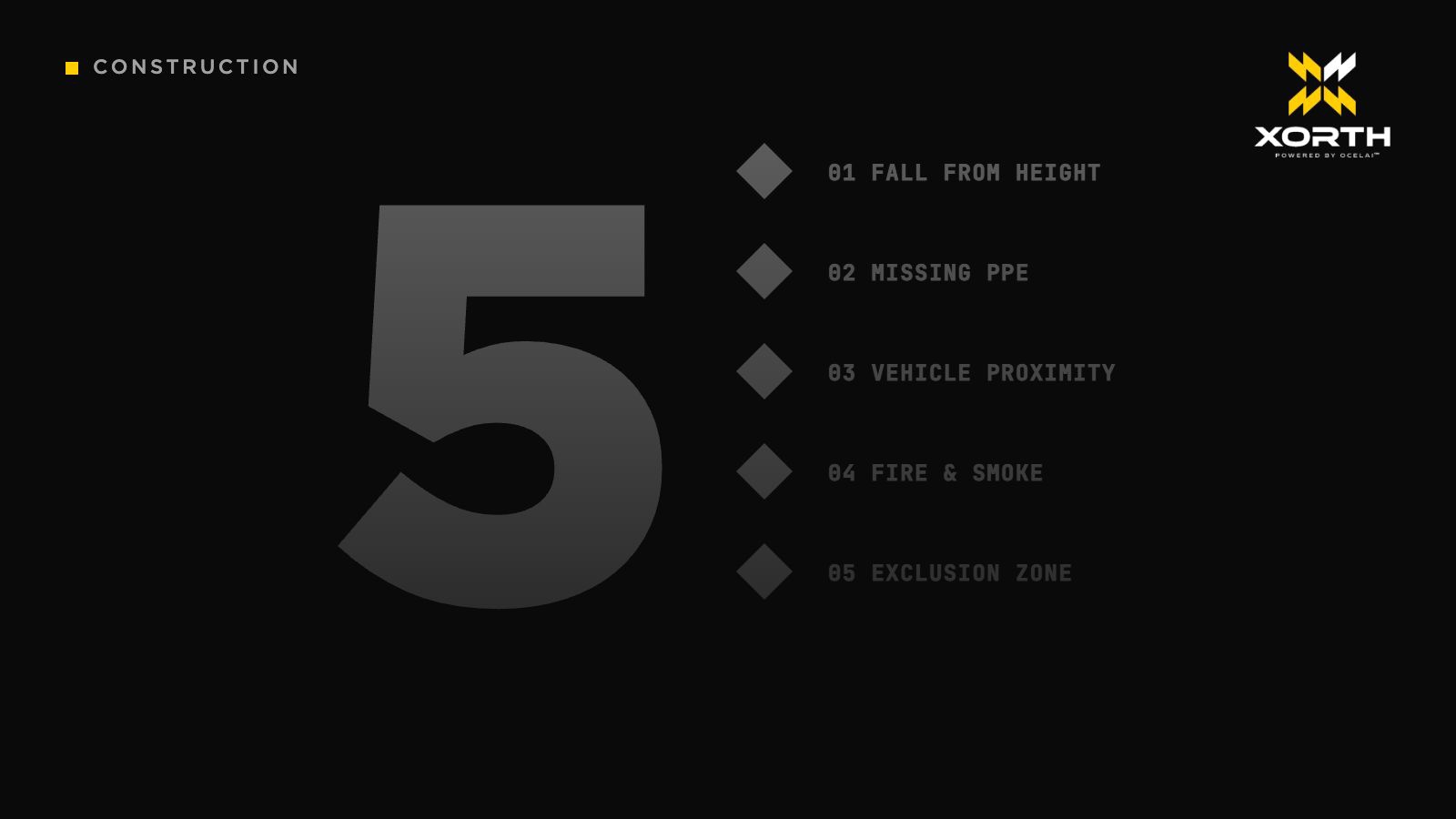
Twenty-four detection models across three domains. Safety covers PPE, work at height and fall arrest, falls and prolonged immobility, crane and lifting proximity, exclusion-zone breach, hot work, fire and smoke, and material stacking. Security covers perimeter and after-hours intrusion, restricted-area access, loitering, ANPR, enrolled-person recognition and material and plant protection. Operations covers zone activity, headcount and entity count, covered-load verification, waste handling, crowding and visitor logging. Ask us for the full model list — which of them a site runs is a configuration decision, not a licensing one.
Can Xorth integrate with our existing security and EHS systems?
Expand answer
Yes. Xorth is an additional layer over your existing operation, not a replacement for it. Events are delivered by email, SMS, in-app, open REST API and signed webhooks, so they can be pushed into your incident register, EHS management system, access-control platform or ticketing tool. Deeper connectors are scoped with your systems integrator.
What happens when something is detected?
Expand answer
The assigned responder receives an alert carrying the camera, the zone, a timestamped evidence clip and the model's confidence score. Every alert is retained with its review state, so you can show who saw it, when, and what corrective action was raised. Detection is probabilistic and always requires human judgement — Xorth surfaces the event and holds the record; your team decides what it means.
Xorth