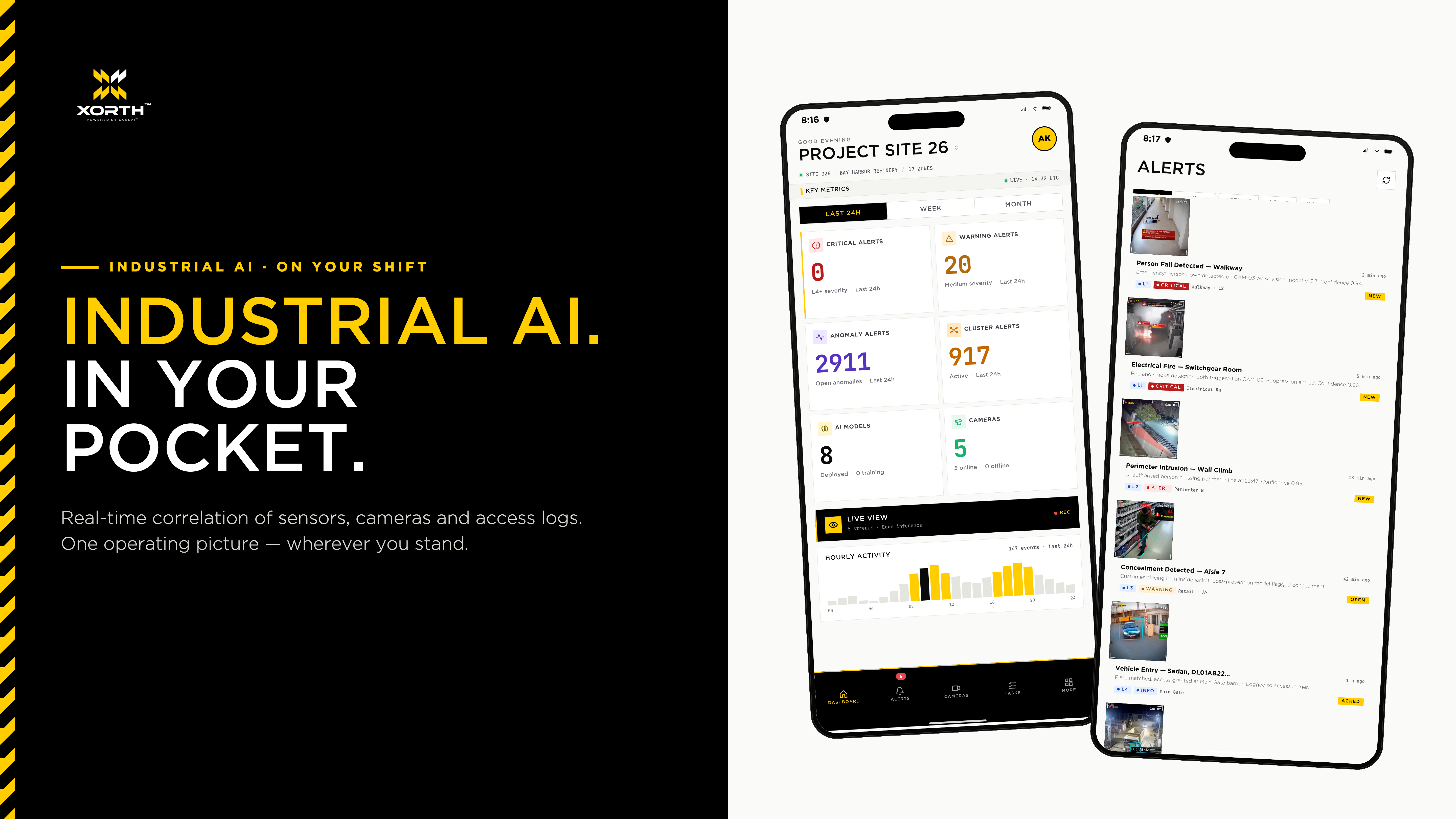
Cameras and access control, fused at the edge into one live picture of your site.


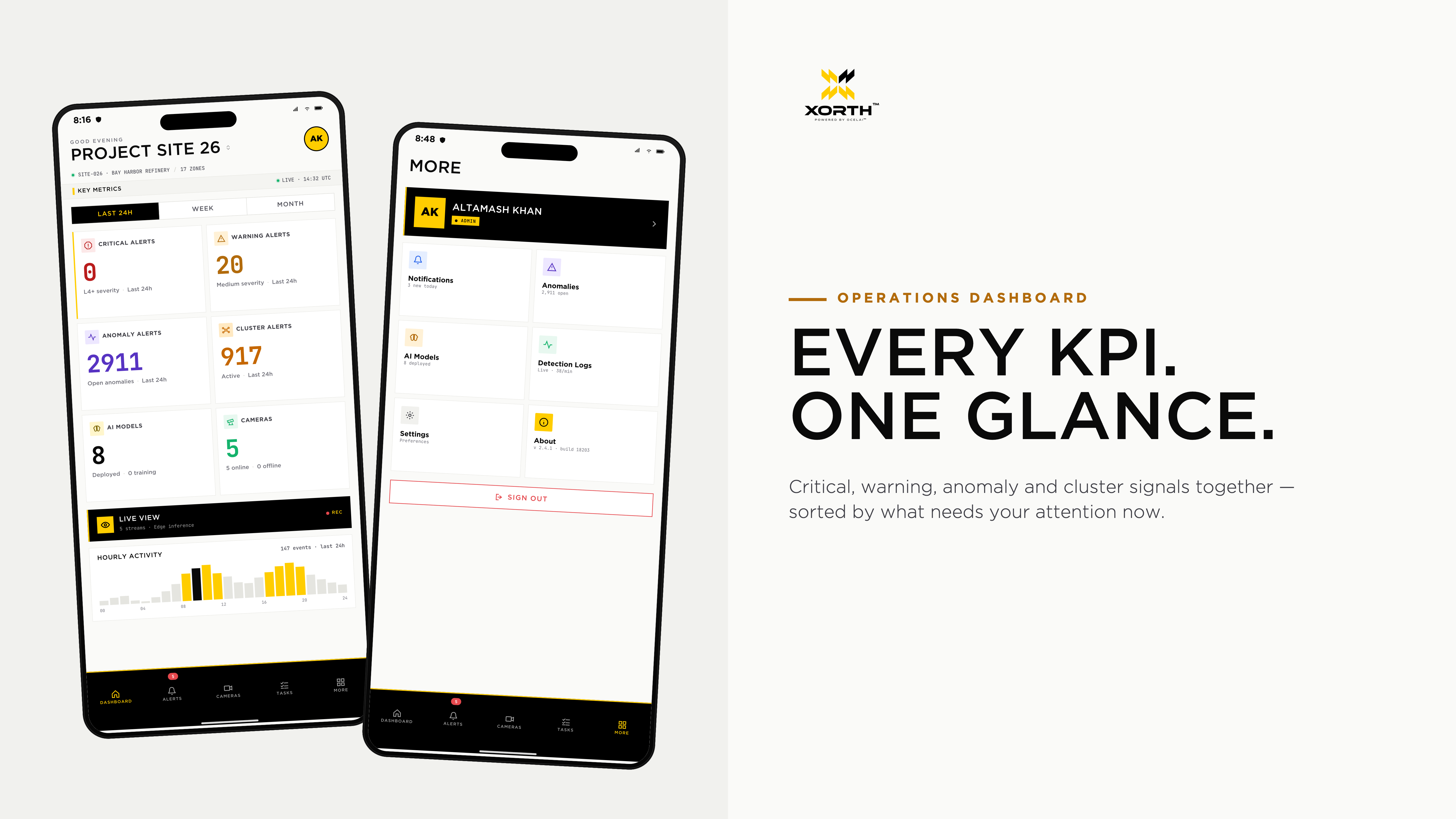
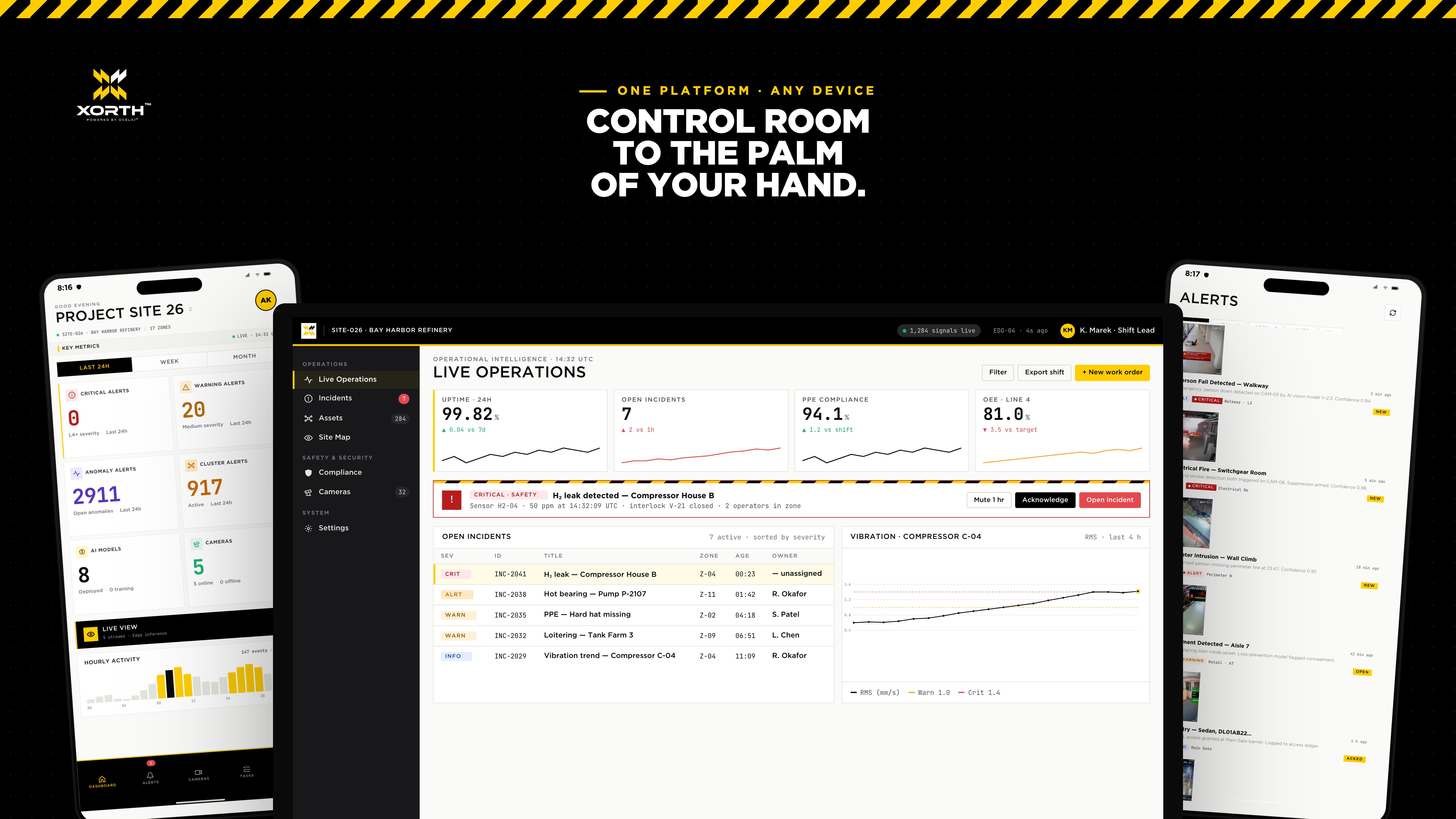
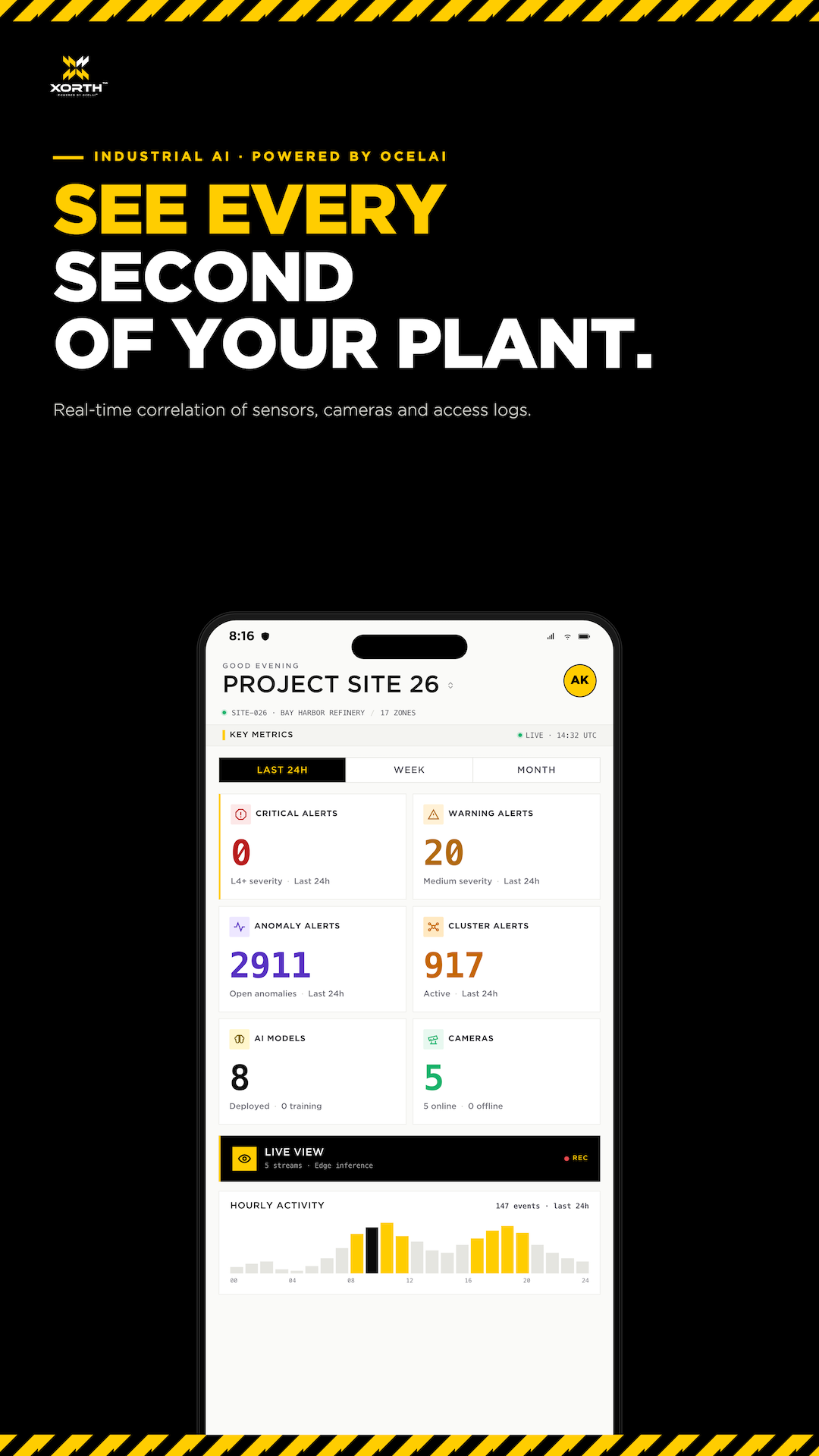
From live dashboards to event-indexed video and scheduled HSE reporting — the full operating toolkit in a single pane of glass.
Live feeds, alerts, compliance, and corrective actions are all visible in one view. Filter by site, zone, model, or date without switching systems, ensuring managers get answers quickly.
A customizable grid for operators monitoring feeds. When a model triggers, the relevant tile is highlighted, focusing the operator's attention effectively.
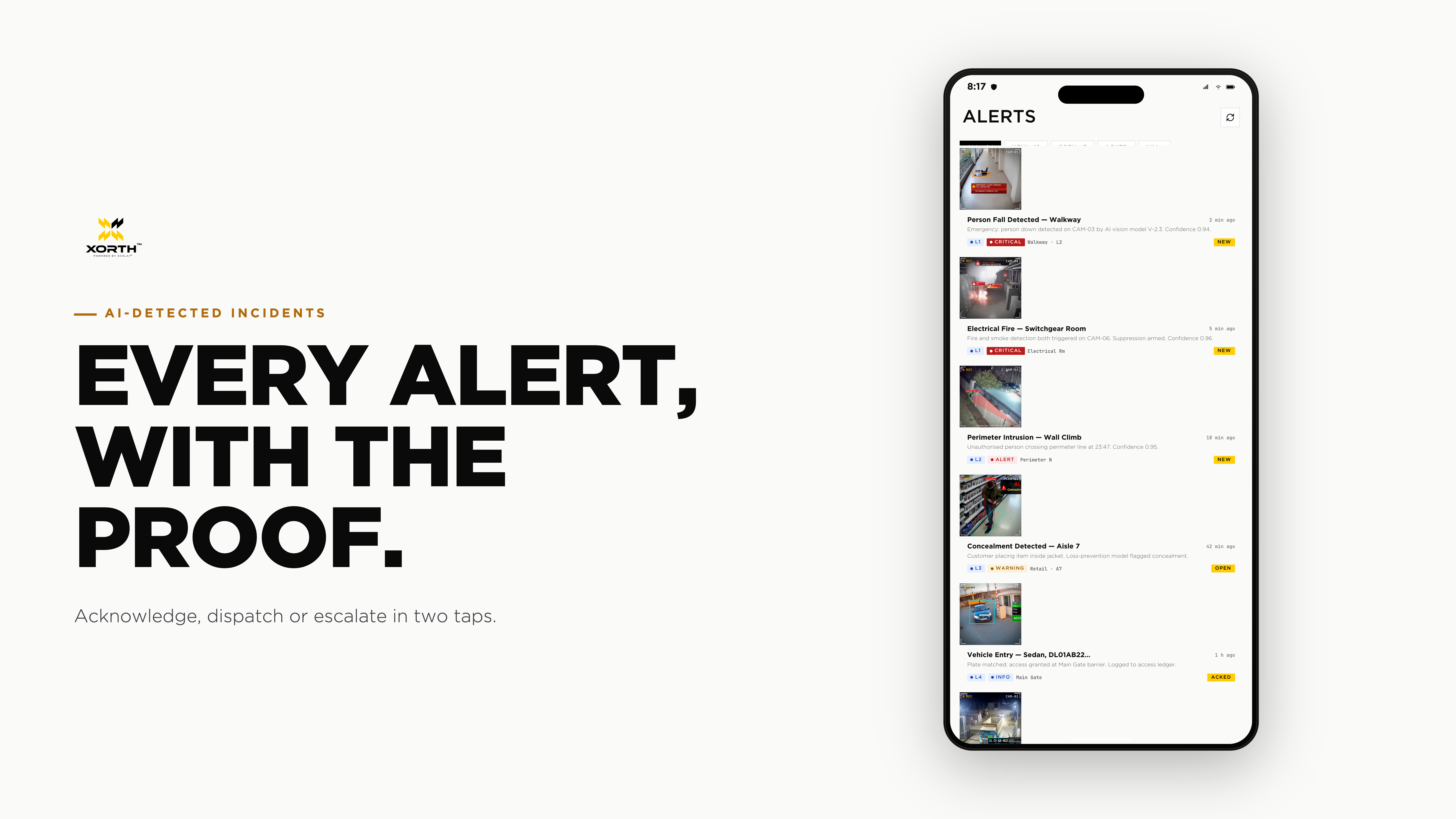
Custom alerts via SMS, email, or app, routed by zone and shift to reach the right person. Combine models to create meaningful alerts, reducing noise and preventing alert fatigue.
Detections trigger tickets with clips and details, ensuring every event is tracked and resolved, turning detection counts into actionable metrics.
Xorth indexes each frame by detected events, allowing you to filter by model, camera, or date to find specific clips, turning footage into actionable evidence.
Organized archive with customizable retention policies to meet data-retention standards and statutory obligations.
Daily, weekly and monthly PDF or CSV reporting — observation counts, PPE compliance by zone, exclusion-zone breaches, open corrective actions. And, more usefully than a count: how long people were actually exposed. Ten seconds inside a swing radius and forty minutes inside it are the same violation on a tally sheet and completely different risks. Reporting is built for the monthly HSE review, a payment draw or an audit.
The system logs itself, not just the site. Every alert raised, every alert viewed, every clip exported and by whom — held under role-based access control and exportable. An auditor asking "who knew, and when did they know it" gets an answer from the log rather than from a meeting.
Granular permissions for site engineers, safety officers, security leads, clients and auditors, enforcing least privilege across the estate.
The quiet failure mode of every analytics deployment is a camera that stopped streaming three weeks ago and nobody noticed. Xorth tracks the health of every connected feed and alerts when one drops — because a blind camera is a hole in the evidence you will later be asked to produce.
Where the models run decides what happens when the link drops. In on-premise deployments inference runs on a GPU server at the site: detection continues through an internet outage, events queue locally and synchronise when the link returns, and the record has no gap. In private-cloud and hosted modes the site needs its connection to the inference tenancy, so a prolonged outage does interrupt detection. If uninterrupted local detection matters, specify on-premise in the order form.
Xorth is designed to be a source of events, not a destination. An open REST API, an SDK and HMAC-signed webhooks push every detection into the system your team already opens each morning — EHS management, ERP, ticketing, access control. Purpose-built connectors beyond that are scoped with your integrator rather than promised on a website.
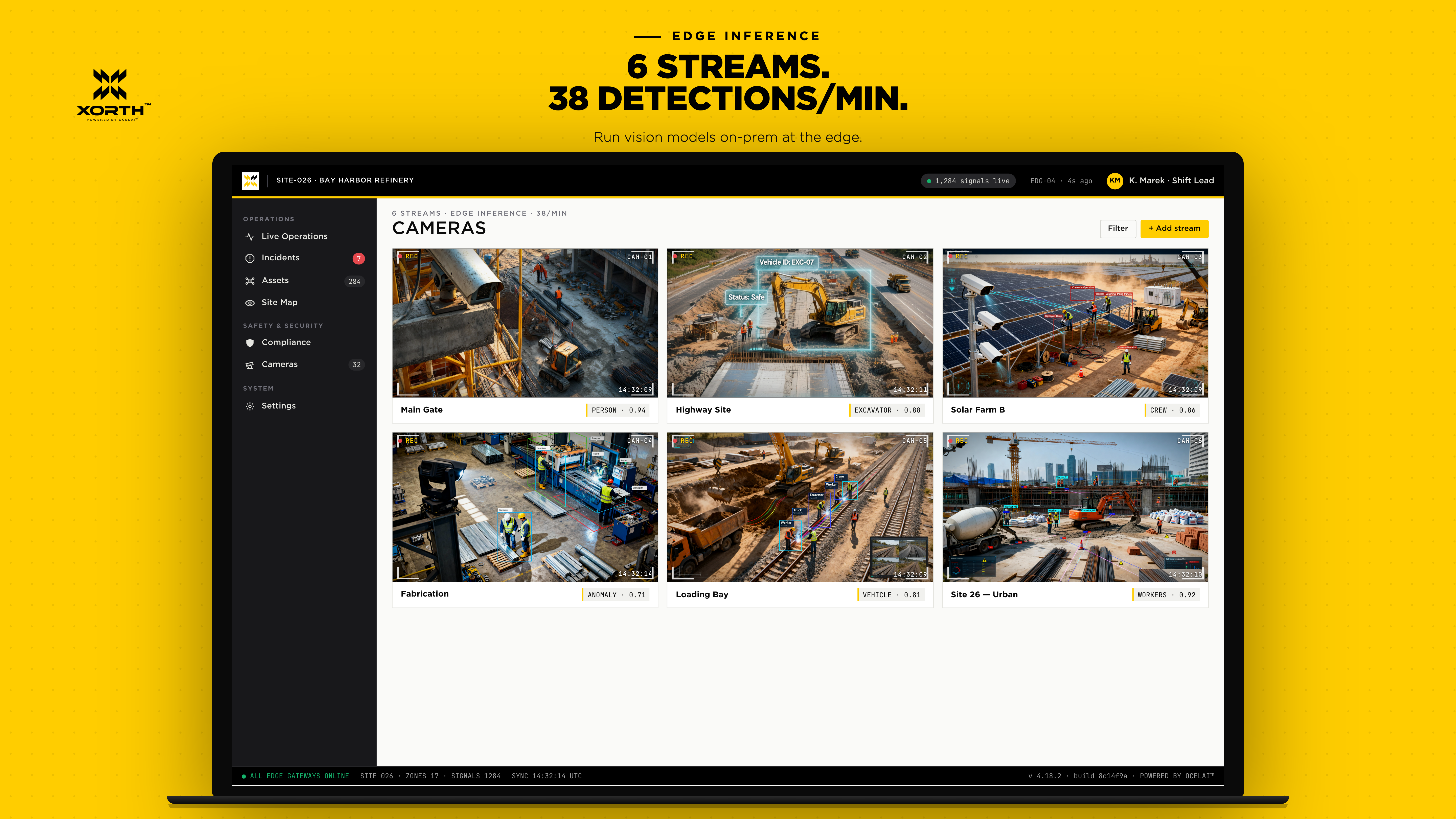
Twenty-one AI detection models on your existing CCTV cameras for safety, security and site-operations intelligence.
Verifies covered-load compliance for every C&D waste vehicle leaving the site, with a timestamped clip behind each movement.
Measures worker dwell time in each zone — active versus inactive periods — so you can see how long crews spend in an area and where productive time is lost.
Detects unauthorized waste disposal outside designated areas, logging each event with a timestamped clip, preventing unexpected regulatory issues.
Detects helmets, high-visibility clothing, gloves, eye protection, and safety footwear, each linked to specific hazards like falling objects and chemical exposure. Rules are tailored to align safety requirements with actual risks.
Flags workers in elevated zones without a correctly worn harness connected to a suitable anchorage — the control that fails most often and costs most when it does.
Identifies a fallen or immobile worker and raises a priority alert to the site supervisor with the location attached.
Tracks personnel entering the swing radius and the path of suspended loads — the line-of-fire exposure your lifting plan exists to prevent.
Visual early warning at the first signs of fire or smoke — alongside, never replacing, your statutory detection and suppression system.
Alerts on entry outside working hours or into no-go zones, and distinguishes a person on the perimeter from an animal.
Flags unauthorised entry to active plant areas, energised equipment, material stores and no-go perimeters.
Reads and logs vehicle number plates entering and leaving the site perimeter, with unread plates flagged for review rather than silently dropped.
Monitors stored materials, fuel and plant for unauthorised movement or removal.
Xorth is a CCTV analytics platform. That is the whole product and we would rather be clear about it than imply a suite we do not build. But a site is rarely watched by cameras alone, and the record a project needs rarely comes from one source. These are the systems Xorth sits alongside — some delivered with partners, some connected through the API. We will tell you on the call which is which and who does what.


SOW accepted, work order signed and your named delivery contact assigned. The 9-week schedule is confirmed and site access requirements shared with your team.
Cloud server provisioned and configured. In parallel: camera hardware validated, NVR/DVR RTSP streams configured and camera angles aligned on-site by your team.
Streams land in the platform. Xorth engineers validate feed health and calibrate detection models to your specific zones, lighting conditions and camera angles.
Site data gathered to fine-tune models for your environment. UAT run with your safety, security and ops teams. One-time training delivered — then you go live.
AI models retrained on your live site data week by week. Personalised dashboard and reporting refined to your KPIs. Accuracy improves every sprint.